Browse Exhibits (8 total)
From Homes to Horizons: The Hidden History of Norris Dam
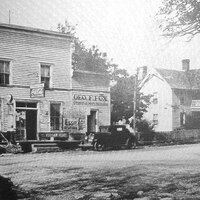
This exhibit examines both the development and evolution of Norris Dam and Norris Lake through the construction efforts of the Tennessee Valley Authority in the early 1930's. The dam itself represents one of the most significant engineering feats of the Great Depression; however, in terms of human cost, the displacement of hundreds of families from their homes, lands and communities to create the reservoir had a devastating impact on those who lost everything.
This exhibit will be divided into two parts. The first section will focus primarily upon the experiences of those displaced, including the uncertainties, losses and disruptions caused by these transitions. Utilizing photographs, documents and primary accounts from those affected, it provides an opportunity to highlight some of the perspectives that have historically been marginalized or absent from larger-scale historical interpretations.
The second half of this exhibit will shift its focus to the present-day recreational/tourism uses of this same landscape. Today Norris Lake is used by thousands of people to fish, boat, camp and experience nature, activities which could not be further removed from its former status as an inhabited community.
Through the juxtaposition of historical and contemporary materials, this exhibit illustrates how different meanings can exist in relation to a single location. Ultimately, this exhibit asks you to think about not just what a location is today, but what it once was and whose story may still be hidden under the surface.
Save Our Cumberland Mountains

Save Our Cumberland Mountains is an organization created in 1972 in a Tennessee coalfield community. Originally it was created to investigate why there town's schools and road were recieving less funding than other nearby towns.
They learned that the corporations that owned the nearby mines were not paying taxes on the land. The community banded together and sued the town to require the mine companies pay taxes, and they won. After this victory they decided to transition from just a group of neighbors into a full-fledged community action organization.
SOCM was founded to serve five Tennessee counties who all face the similar impacts of coal mining. They address tax reform, strip mining policy regulations, and other initiatives to serve their communities.
The organization has since expanded to include all of Tennessee and renamed to Statewide Organizing for Community eMpowerment. Despite these changes they are still focused on addressing the issues that the organization was founded on.
Invisible Lines: Social Dynamics of the Nuclear Age
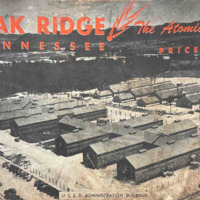
The construction of Oak Ridge, Tennessee was a significant turning point in World War II.
Built as a major site of the Manhattan Project, the U.S. Army Corp of Engineers purchased 60,000 acres of farmland to construct a city that was meant to be temporary, in order to produce the first atomic weapons through its facilities.
While the "Secret City" was primarily used for the placement of the K-25, Y-12 S-50, and X-10 plants, this large of an operation required vast amounts of brute work. By 1945, over 70,000 people were employed within these borders.
To house employees and their families, small neighborhoods were constructed. With over 44,000 living quarter units (between family homes, apartments, dormitories, and hutments), Oak Ridge was as vibrant as the other top 4 most populous towns of the time. Featured in the city were shopping options, schools, entertainment, and other amenities for its employees and their families.
However, Oak Ridge was home to more than just thousands of workers. It featured unjust social dynamics for many, including nonwhite individuals, single or unmarried couples, and women.
American Amber: Transformation and Ossification in Norris, Tennessee
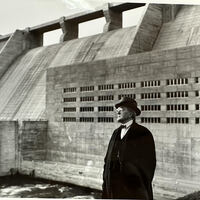
In 1936, the yet-unproven Tennessee Valley Authority completed their first major infrastructure project: the Norris Dam. Exited by this achivement, the TVA celebrated it's victory and left Norris to begin other myriad constructions across the country.
But the TVA had already left it's mark on Tennessee. Not only did the dam itself transform the Norris area, but the human communities that the TVA left in the dam's shadow remain to this day.
Efforts by the Smoky Mountains Hiking Club in the Great Smoky Mountains
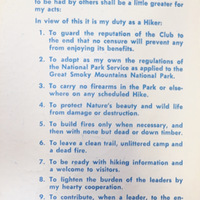
The Great Smoky Mountains were established as a National Park in 1934 with the help of the Smoky Mountain Hiking Club, which was created a decade earlier in 1924. The club helped shape how people viewed the area for recreational use and for preservation.
The club released yearly handbooks to inform members of the club and members of the community of upcoming events and hikes that year. Each year, the handbook began with a message from their current president highlighting their environmental achievements from the previous year. Their message encouraged people to stay involved and continue to protect the National Park.
The club promoted outdoor education, social events, and community involvement. Even during challenging times, such as wartime restrictions, they adjusted their programs to keep people engaged and active in the outdoors. This showed how important recreation and connection to nature were, even in difficult times.
The work the SMHC did helped other organizations advocate for respect and responsibility toward the park while also creating better trails for the public. Their main goal was to show people the beauty of the park while also educating everyone on keeping the park clean and safe. These clubs helped shape the Great Smoky Mountains into the National Park it is today.
Protecting the Mountains: Conservation Organizations in East Tennessee
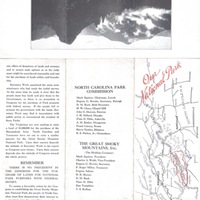
East Tennessee's mountains have a long history of people fighting to protect them, but the way people fought and who they were fighting for changed a lot over time. This exhibit looks at three different groups who shaped the region's environmental history: the advocates who pushed to create the Great Smoky Mountains National Park in the 1920s, the hiking clubs that took on a stewardship role after the park was established, and the coalfield residents who organized against strip mining and corporate exploitation in the 1970s and 80s. These groups did not always share the same goals or methods, but together they show that conservation in East Tennessee meant different things to different people depending on where they lived and what they stood to lose.
Packaging Progress: Brochures, Blueprints, and the TVA’s New South
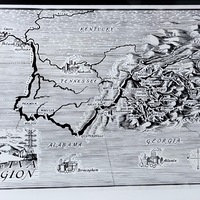
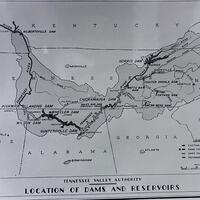
An exploration of how the TVA presented their environmental engineering of the Tennessee valley region to the public.