The People's Relocation
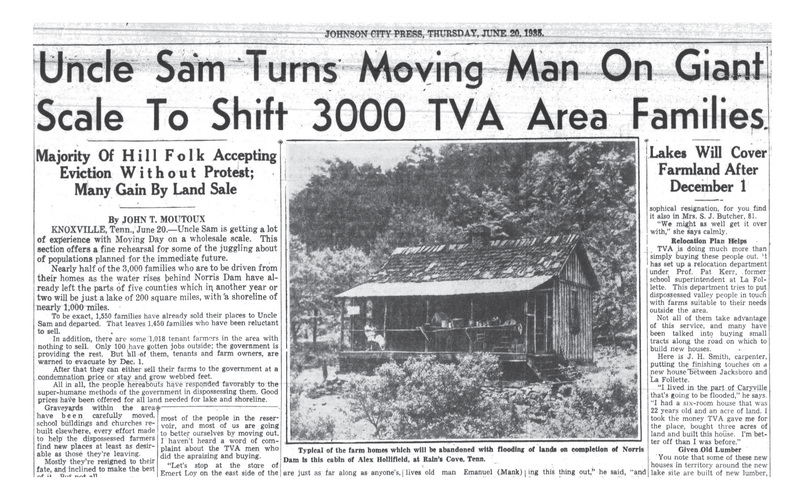
The 1935 newspaper article "Uncle Sam Turns Moving Man on Giant Scale to Shift 3000 TVA Area Families" portrays the construction of Norris Dam as a large-scale governmental project, but an orderly one. The title alone creates an image of the U.S. Government as a giant machine, able to move thousands of people from their homes with precision. The author states that "the majority of hillfolk have accepted eviction without protest," which indicates that there is a degree of cooperation or even approval. Nevertheless, this statement does not indicate the deep sense of dislocation felt by those who are moving away.
Upon closer inspection of the article, the scale and complexity of the relocation become apparent. The author reports that nearly 3,000 families will have to vacate their homes because the water level will rise due to the creation of the dam. According to the author, the new lake will cover an area of "200 square miles." Although the author writes about most families having previously sold their land; however he also mentions that approximately 1400 families did not want to relocate. Thus, this complicates the notion that all families relocated willingly.
In addition to the impact of relocation upon family property rights, churches and schools were taken apart at their original location and rebuilt in other locations, while cemeteries were "taken down and carefully moved"; thus requiring the exhumation and re-burial of hundreds of deceased. Such examples show that in addition to displacing people from their homes, the TVA's effort also destroyed local institutions (i.e., church, school) and broke ties with past generations. In fact, even the dead were moved; showing how profoundly this project impacted the social/cultural landscape of the region.
Despite repeated statements within the article regarding the efficiency and fairness of government actions ("good prices for land", "organized relocation"), there is indirect evidence contained within the article of losses incurred during this time. Evidence of such can be found in descriptions of families leaving homes and beginning anew. Such descriptions illustrate a forced transition for these families and do not show a smooth transition. Additionally, images of a "typical farm home" left behind reinforce this conclusion and demonstrate what types of environments were lost when they flooded the basin.
In contrast to the TVA's assertion that Norris Dam represented advancement through modernization and increased economic opportunities, this article demonstrates the human cost associated with this type of development. As described above, beneath its positive message exists a reality of dislocation for families, communities, and even burial sites in order for development to occur. Therefore, as illustrated by examining both how the article has framed the event and the information below it, it can be seen that the construction of Norris Dam represents much more than simply "progress".